


Disaster Recovery Plan: 6 Key Steps to Ensure Business Continuity

Boosted Build

Disaster Recovery Plan isn’t just a skip option now-a-days — It’s a need that must be fulfilled. It’s a must -have element that every business requires. Let’s think of an example — You started a business, you planned all the strategies for business marketing and growth, you also created a business recovery plan and at the end any physical attack or natural disaster occurs and your team don’t know what to do? Whom to consult with or which document they should follow!
Now that’s the point where disaster recovery planning comes into notice. It’s a comprehensive guide that tells everyone what to do and how to do in any emergency situation!
In this article, we’re going to talk about the 6 primary steps included while creating an efficient disaster recovery plan.
1. Assess Potential Risks
Firstly, a step-by-step DRP must initiate potential risks first in order to lessen the risk percentages. Risks like natural disasters(storm or fire), physical attacks(jumping the fence) or any human-made threats (cyberattacks or data leaks) are considered as potential risks. Recognize, analyze and categorize each risk based on its emergency percent and their impact on your business.
Types of risks to take into notice:
- Natural or physical attack: Earthquakes, floods, fires, tailgating, shoulder surfing
- Cybersecurity Risks: Malware, ransomware, hacking, APT
- Hardware Downtime: Server breakdowns, power outages, system failures
- Human error: Accidental deletion, poor maintenance practices, inconsistent data backups
Once you’ve initialized the risks, you can list them to concentrate on the most likely and damaging threat or scenarios.
2. Define Recovery Objectives
Secondly, take a look at your business recovery objectives, which are mainly considered as Recovery Time Objective (RTO) and Recovery point objective (RPO). Let’s see what are these 2 statements:
- RTO: The amount of time your business can tolerate being down before it makes any impact on critical functions, is referred as Recovery Time Objective (RTO).
- RPO: When we’re talking about the maximum amount of loss of data business can bear, then we call it the Recovery Point Objective.
By setting realistic RTO and RPO aims, you can design your recovery plan to fulfill these objectives, ensuring continuity and minimum loss of data.
3. Pick out Critical Business Functions
Next, it’s necessary to find out the critical business functions that must remain in work even in downtime or during a disaster. These are the functions that are vital for your business’s survival, such as payroll systems, customer data, or investment records.
- Create a priority list: Ranking these functions based on their importance in business is necessary for any disaster recovery plan.
- Determine dependencies: Identify the systems, applications, and personnel necessary for each critical function to run smoothly. This allows you to focus on safeguarding these elements in your recovery plan.
4. Implement Data Backup Solutions
At the heart of any disaster healing plan is facts backup. Without reliable backups, it’s impossible to recover lost statistics. implement a strong backup and recovery solution that aligns with your RPO objective.
Types of backup solutions:
- Cloud-based backup: Stores data remotely, providing off site protection and scalability.
- On-premises backup: Includes storing records locally, presenting faster restoration but calls for maintenance.
- Hybrid backup: An aggregate of cloud and on-premises backup, providing a balance of speed and safety.
Automate your backup techniques to ensure that your information is included at all times and perform ordinary assessments to confirm that your backups are complete and on hand.
5. Develop a Detailed Communication Plan
A disaster recovery plan is only as powerful because of the communication strategy in the back of it. Your crew needs to recognize who to contact and what steps to take during a disaster. increase a clear verbal exchange plan that info the roles and responsibilities of each group member within the occasion of a disaster.
Key elements of the communication plan:
- Contact information: Make certain that you have up-to-date contact info for all personnel, providers, and stakeholders.
- Response teams: Designate specific groups answerable for coping with the up to date manner, such as it, HR, and control.
- Communication channels: Set up multiple ways to communicate (e-mail, cellphone, messaging apps) in case one device is down.
Regularly replace and evaluate this plan and make sure its effectiveness.
6. Test and Update Your Disaster Recovery Plan
A disaster restoration plan is not something you create once and forget about approximately. Everyday checking out is vital to make sure that your plan works in real-world situations.
Testing methods:
- Simulated disaster drills: Run mock scenarios to test how well your team and systems respond to a crisis.
- Data recovery tests: Test your ability to recover data within your set RTO and RPO targets.
- Review and update: After checking out, review the effects and replace your plan to cope with any shortcomings.
Periodic trying out guarantees that your disaster recovery plan stays effective as your commercial enterprise grows and technology evolves.
Conclusion: Ensure Business Continuity with a Solid Plan
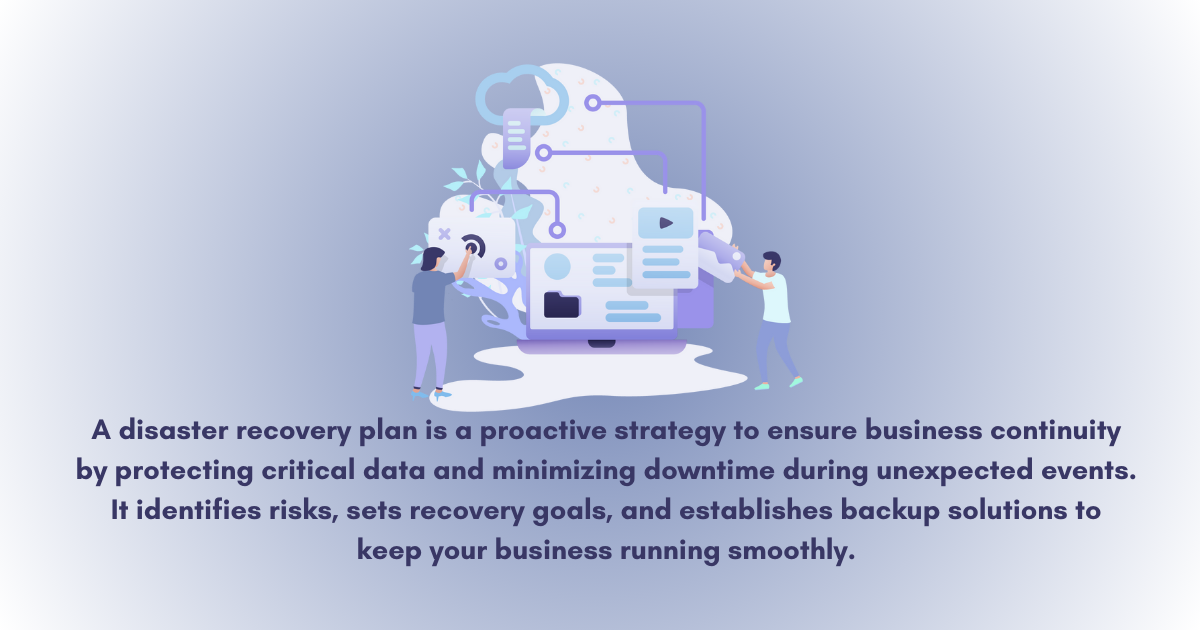
Implementing a complete catastrophe recovery plan is critical for any commercial enterprise trying to make sure continuity within the face of sudden activities. With the aid of assessing dangers, defining recovery objectives, and putting in reliable backup answers, you can minimize the effect of screw ups in your operations. Do not look forward to a catastrophe to strike! Contact us to help you broaden a customized catastrophe restoration plan that maintains your business safe and going for walks smoothly.