


Single Page and Multi Page Application

Boosted Build
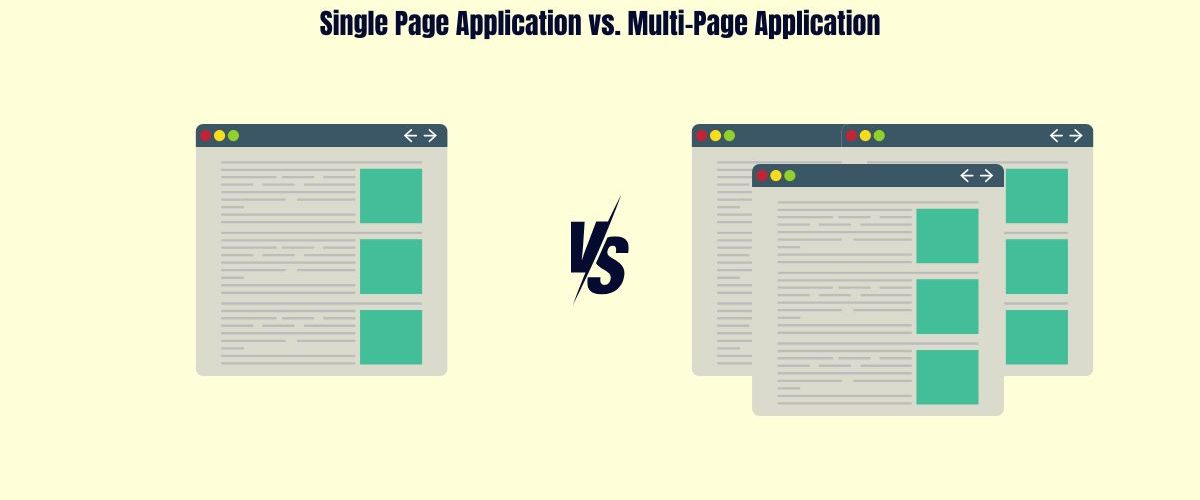
What type of application should you use while creating a project, comparing Single Page and Multi page Application—it’s simple, check your requirements and start your project! These two application types are equally important and have their own strengths and features. Also have some drawbacks and weaknesses. Just using them—all depends on your project type and your consistent requirements.
So in this blog we’ll compare these two types of applications and check out which type is better to use, in different situations. So let’s skim below:
Defining Single Page Application (SPA)?
A type of web application that loads a solely HTML page and continuously updates when users engage and interact with the app is called Single Page Applications (SPA).
SPAs usually work with fetching data and rendering directly in the browser, rather than loading entire new pages from the server. These applications can be made via Javascript Frameworks like React, Angular or Vue.js—can called Angular SPA, React SPA or Vue.js SPA.
How SPAs Work:
- The initial load involves downloading the main HTML page and essential resources (like JavaScript, CSS).
- Subsequent interactions with the application only fetch the data that’s needed to update the page, without reloading the entire page.
- In the background, SPAs need AJAX requests and APIs to connect with the server.
What is a Multi-Page Application (MPA)?
A web application that’s also called a traditional model where each user action (like login or sign up) results in creating a new page request to the server is called a Multi-Page Application. MPAs typically involve complete page reloads and more significant changes in the content that the user interacts with.
How MPAs Work:
- Each page is independent, meaning that when a user clicks on a link, a full-page reload is triggered, fetching new HTML from the server.
- MPAs are often structured with multiple HTML files, each containing different sections or functionality.
Key Differences Between SPAs and MPAs
1. Performance and Speed
- SPA: The performance of SPAs tends to be better after the initial load. When the SPA page is loaded, it provides a quick and fluid user experience as there’s nothing to refresh the entire page. Hence, server load-time reduces—enhancing browsing experience.
- MPA: Came usually with slower performance, MPAs needs to reload full-page each time a new page requested. This approach can provide less seamless experience & increase server load time.
2. SEO Optimization
- SPA: Search engines can’t index dynamically loaded content, hence this can be a drawback of using SPAs. But newer technologies like server-side rendering or pre-rendering can cure this problem.
- MPA: While MPAs can have a big advantage of SEO, as each page can be indexed and loaded separately. Search engines can easily index and crawl each page, which makes MPAs a better option.
3. Development Complexity
- SPA: SPA development can be more complex. You’ll require in-depth knowledge of Javascript frameworks & their client-side routing. Furthermore, handling things like state management and complex routing might be more difficult in an SPA, requiring additional libraries or tools.
- MPA: MPAs, being more traditional, tend to have a simpler development process. They often rely on server-side rendering, which is easier to implement for developers familiar with traditional web development. Additionally, MPAs don’t typically require complex client-side JavaScript libraries, making them easier to set up and maintain.
4. Scalability
- SPA: These applications are more scalable when it comes to putting new features or sections within the same framework. However, a challenge can arises, when site continuously grows, handling client-side architecture and keeping everything in sync can be difficult
- MPA: MPAs can scale well when it comes to adding new pages, especially when each page is separate and independently managed. Since each page is often isolated, updates or changes can be implemented with less risk of disrupting the entire application.
When to Choose a SPA
- Dynamic User Interaction: SPAs can be an ideal option for applications that need real-time data updation or dynamic user interactions.
- Mobile-First Experiences: SPAs are more smooth & have app-like behavior, hence applications are well-suited, when mobile-first designs are necessary.
- Faster Subsequent Interactions: If your application requires minimal loading after the initial page load, a SPA will significantly improve speed and performance.
When to Choose an MPA
- SEO Importance: To rank higher and be prominent in search engines, MPAs can provide an option of unique and indexable pages.
- Simple User Experience: MPAs can provide your more comprehensive solution, if your site has less interactivity and doesn’t require real-time data updates.
- Legacy Projects: If you’re working with an existing system that is built with traditional multi-page structures, an MPA might be more compatible without requiring a complete overhaul.
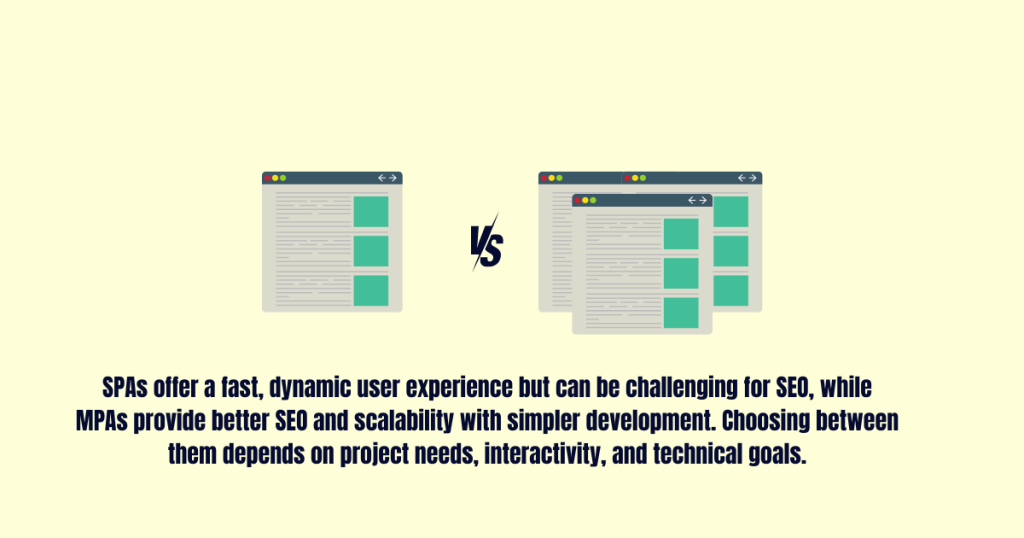
Conclusion: SPA vs. MPA – The Best Choice Depends on Your Needs
Concludingly, both types of applications—Single Page Application and Multi-page Applications are effective according to their preference and needs. They’re most likely to be used according to the requirements and nature of your project or application. Talking about features and needs for these applications—SPA would be a good option. When you need dynamic, real-time or interactive user-experience, While MPA would be effortlessly good for doing SEO, scalability & simplicity.
At last, the selection decision can be made by defining technical requirements of your project & the goals you’re targeting to obtain. By deeply understanding the features of both types you’ll get a broad idea of what, when and how to prefer which type of application.
So understand and Develop—HAPPY DEVELOPING!
Your blog is a constant source of inspiration for me. Your passion for your subject matter is palpable, and it’s clear that you pour your heart and soul into every post. Keep up the incredible work!
Thank you so much for your kind words! I’m glad you found the post clear and helpful. Your support means a lot.
Just wish to say your article is as surprising The clearness in your post is just cool and i could assume youre an expert on this subject Fine with your permission allow me to grab your RSS feed to keep updated with forthcoming post Thanks a million and please keep up the enjoyable work
Thank you so much for your kind words! I’m glad you found the post clear and helpful. Your support means a lot.
Your blog is a true hidden gem on the internet. Your thoughtful analysis and engaging writing style set you apart from the crowd. Keep up the excellent work!
Your blog is a true gem in the world of online content. I’m continually impressed by the depth of your research and the clarity of your writing. Thank you for sharing your wisdom with us.
This is such a valuable article! 👏 I really like how you’ve managed to explain the topic in a clear and practical way—it feels authentic and easy to relate to. Reading it gave me some new perspectives that I can actually apply. I’m especially interested in content like this because at meinestadtkleinanzeigen.de we’re running a classifieds and directory platform in Germany that connects people with services, businesses, and opportunities across many categories. Insights like yours remind me how powerful it is when knowledge and connections come together. Thanks for sharing—looking forward to more of your work! 🚀