


Social Media Analytics: Measuring ROI

Boosted Build
Leveraging Social Media Analytics for Actionable Insights: Measuring ROI
When it comes to marketing today, social media analytics reigns supreme; this underscores the need to quantify effectiveness of your social media drives. You can no longer just post whatever comes into your head on these platforms without evaluating the results of such moves.
This means having to analyse how effective our posts have been on different platforms using their analytics tools so as to know for instance if Facebook is more advantageous than Twitter or Instagram.
This blog is about how to maximise your social media ROI by using analytics on social media.
Why Social Media Analytics Matter
Social media analytics provides a lot of information about the audience, content performance, and overall effectiveness of the campaign. This data can be employed to:
Measure reach and engagement:
Keep an eye on how many views you get, how many people interact with your content (such as by liking it or leaving comments), and see if it resonates with the audience at large.
Identify top-performing content:
Observe which sorts of content your community appreciates most, thus enabling you to produce a similar version and enhance your tactics.
Track website traffic and conversions:
Examine the role your social media marketing has played in driving people to your website and ultimately converting them into customers or subscribers (sales, signups etc.).
Understand your audience:
Moreover, understand your audience better by knowing their tastes, age group, gender, behaviours and occupation. To ensure high engagement of your content and messages, it is possible to personalise them.
Optimise your budget allocation:
You can optimise your budget allocation by utilising performance data so that you can spend your social media budget more effectively on strategies and platforms that yield the best outcomes.
Key Metrics to Track on Social Media
There are numerous social media metrics to consider, but some key ones include:
Reach:
It is the amount of distinct people that have seen what you posted.
Impressions:
It refers to the total number of times that your content has been displayed.
Engagement:
It includes likes, comments, shares, saves, clicks among others.
Click-through Rate (CTR):
The proportion of people who have clicked on a certain hyperlink within your website.
Conversion Rate:
It may not be easy to deal with the conversion rate, but one can argue that a detailed discussion of it might help unveil how things work around this context.
Transforming Data into Actionable Insights
Identify the key metrics to track had better be translated into actionable insights on how to do so and these are the following tips:
Set clear goals:
Moreover, clarity in your social media objectives are the goals. Would you want increased brand awareness, drive website traffic or generate leads? Additionally, the clearest way to distinguish the most relevant metrics that should be tracked is by having these goals in mind.
Benchmark your performance:
Monitor how you are doing and evaluate your results against industry benchmarks as you go along. This will give you insight into your relative performance with respect to others.
Dig deeper:
Stop paying attention only to the most basic information. Try to comprehend the real reasons for the figures. For instance, consider such things as demographics and audience behaviour, and content performance.
Experiment and adapt:
Compare different content formats, posting times, and targeting strategies using A/B testing, refine your approach and optimise content for better results based on data.
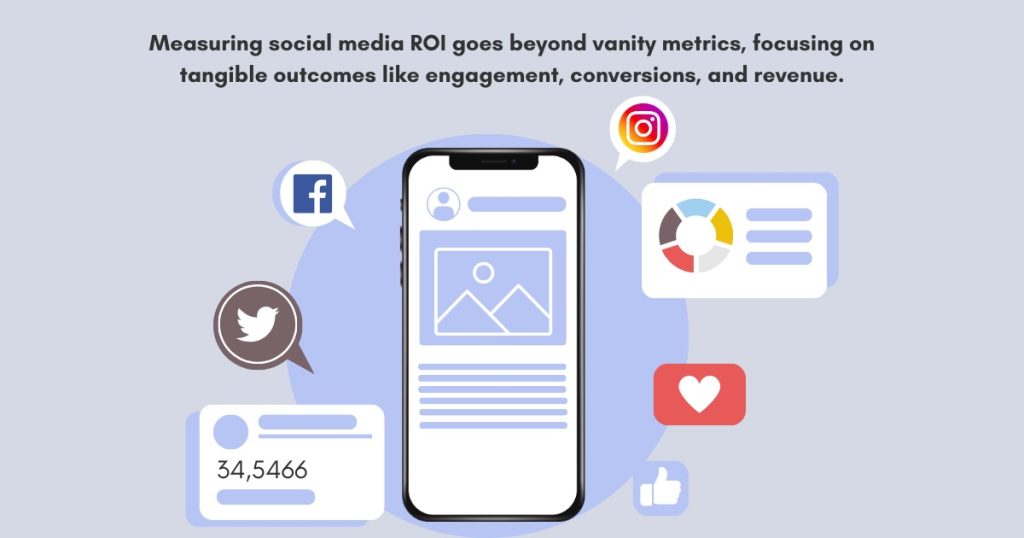
Measuring Social Media ROI: It’s Not Just About Vanities
In many instances, individuals often gauge their achievements online by the number of people following their pages and liking their posts on Facebook or Instagram. However, is this always the case for every business in terms of making money out of such measures like follower-ship or likes? For this reason, focus on other measurements instead that relate better with general marketing objectives.
For instance; if you want people coming through your page as potential customers to identify the total number of prospects through this channel then work out its cost per lead – enabling one to measure actual return investment from using social networks while pinpointing possible areas of change.
Conclusion
The digital marketing proficient find social media analytics powerful. You can harvest the information’s strength and convert it into actionable insights.. That can become successful actions, thereby improving return on investment and eventually boosting the profits of a business.
Would you like to realise the true power of your social initiatives? To get started, have a comprehensive look at how your efforts are performing using social media analytics! Furthermore, take part in this discussion about how we have made use of them. Or the challenges experienced in the use of social media analytics below.